Behaviour starts in the body.
Regulation and connection come first.
InnerMe supports children, families and servicesacross the UK to understand what’s really driving
behaviour and respond in ways that reduce distress,build safety and protect relationships.
What the InnerMe Project Is
What is InnerMe?
The InnerMe Project is a worldwide, regulation-led approach to supporting children with
complex needs and the adults around them.
Instead of asking “How do we stop this behaviour?”
InnerMe asks “What is the body telling us .....and what does it need right now?”
By focusing on regulation and connection, InnerMe helps shift responses away from blame,
punishment and power struggles, towards support that actually works in real life.
How InnerMe Approaches Support
✔️ Behaviour is understood as a signal, not a problem to fix
✔️ Regulation is prioritised before learning, reasoning or change
✔️ Adults are supported to respond with consistency and clarity
✔️ Relationships are protected, even during limits and boundaries
✔️ Support fits real homes, schools and services, not ideal conditions
This approach brings calm, predictability and shared understanding into systems that often feel
overwhelmed and reactive.
THE REGULATION RHYTHM FRAMEWORK
A shared framework for understanding behaviour
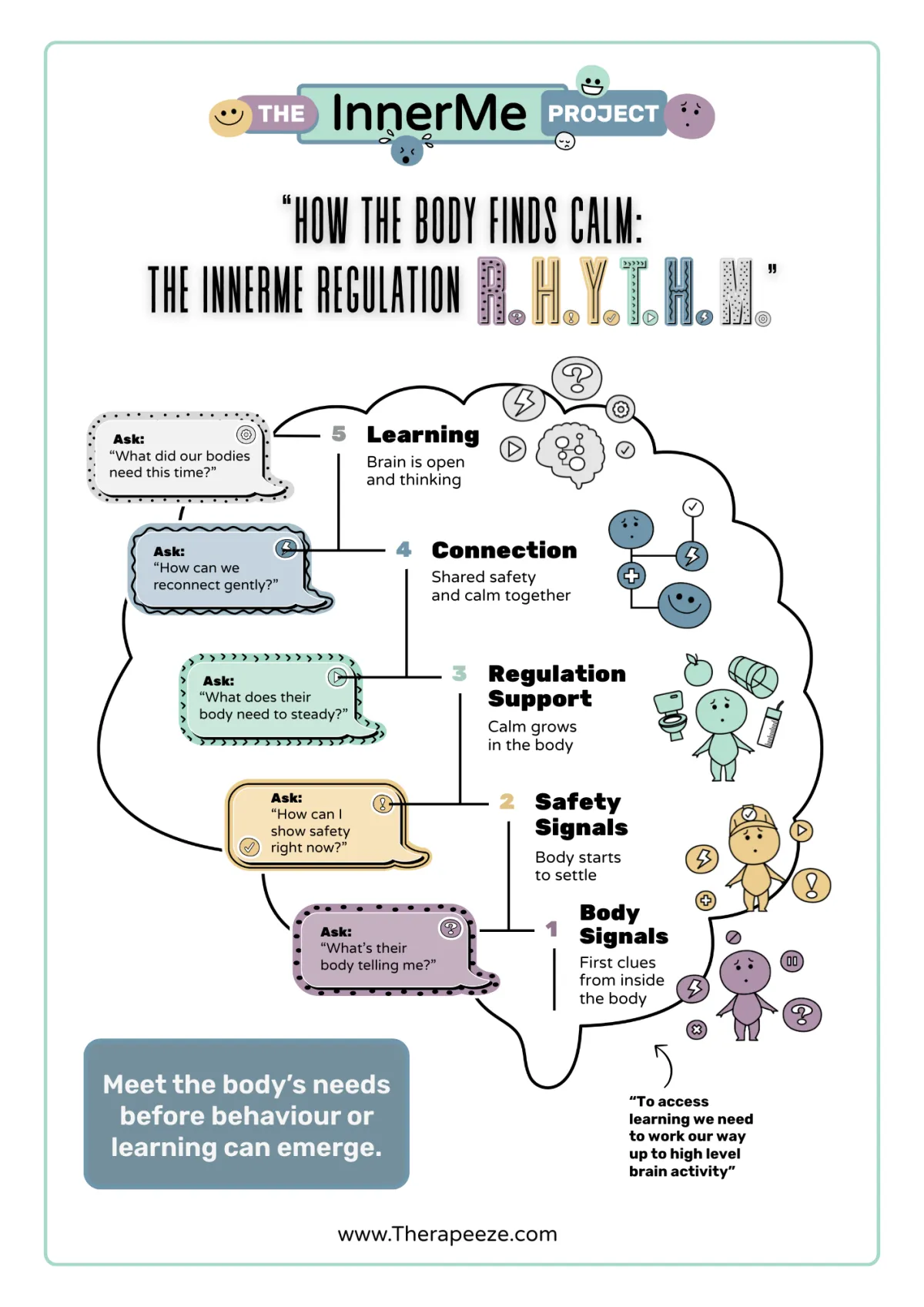
The Regulation RhythmTM is the core framework that underpins all InnerMe work.
It provides a clear, repeatable way for adults to recognise distress early and respond in ways
that support safety and regulation.
The Regulation RhythmTM:
1. Body Signals -Noticing early cues such as hunger, thirst, pain, fatigue, sensory overload or
emotional pressure, especially when a child cannot identify these themselves.
2. Safety Signals - Understanding how adult responses, environment, tone
and predictability impact the nervous system.
3. Regulation Support - Practical, body-based support that helps bring
the nervous system back within a manageable range.
4. Connection - Maintaining relationship during boundaries,
transitions and repair without escalating distress.
5. Learning and Change - Once the body feels safe, skills, reflection and progress
become possible. When adults follow the rhythm, behaviour becomes information not a battleground.
Who the InnerMe Project Is For
Who InnerMe Supports
Children - InnerMe supports children who:
● experience intense emotional reactions or shutdown
● struggle with transitions, demands or unpredictability
● are described as “not engaging” or “hard to reach”
● experience school refusal, reduced attendance or alternative education
● have neuro-divergent profiles, trauma histories or complex sensory needs
Families - InnerMe supports parents and carers who:
● feel blamed, judged or misunderstood
● are exhausted from firefighting daily life
● want to understand why behaviours happen, not just how to manage them
● need support that fits real family routines
● want to respond with confidence, not fear of getting it wrong
Services and professionals - InnerMe supports:
● schools and alternative provisions
● social care and family support services
● therapeutic teams and multidisciplinary services
● early years settings
● organisations supporting children with complex needs
This work is particularly suited to services experiencing high levels of dysregulation, staff
overwhelm, reactive practice or inconsistent responses.

Impact: What Changes when Responses Shifts
What Regulation-Led Support Changes
For Children
● fewer escalations and shutdowns
● increased sense of safety
● improved engagement over time
● stronger, more trusting relationships
For Families
● clearer understanding of behaviour
● reduced stress and self-blame
● calmer routines and transitions
● more confidence in day-to-day decisions
For Services
● increased staff confidence and retainment
● shared language and consistent practice
● fewer crisis-driven responses
● Positive staff well-being
● improved outcomes without increasing pressure on staff
“Once we stopped focusing on behaviour and started focusing on regulation,
everything changed.”
“This gave us a framework we could actually use — even on hard days.”
Meet Kate
I’m Kate, a Sensory and Behavioural Specialist, with a background in Occupational Therapy, supporting children, families and services across the UK.
The InnerMe Project was created after years of working predominantly with children who were struggling to access education, including children who were out of school, accessing education outside traditional settings, or being discharged from services due to being described as “not
engaging”.
I developed therapeutic relationships with children others had been unable to reach, not by pushing engagement, but by understanding what their behaviour was communicating and responding at the level of regulation.
Alongside this, I repeatedly saw parents being misunderstood and blamed, and staff feeling overwhelmed and unsure how to respond — despite their best intentions. Traditional behaviour-based approaches often escalated distress rather than reducing it.
InnerMe was born from both my commitment to children and my determination to support families and professionals with approaches that genuinely work.
At the core of InnerMe is a clear purpose: to support children, families and services to understand and respond to behaviour through regulation and connection. When adults feel confident in how they respond, systems become calmer, relationships strengthen, and children are better able to engage in everyday life.

Find the Right Support...
If you're not sure where to start, begin with The Regulation Rhythm